

Hip Pain
Expert Diagnosis and Treatment for Hip Pain — Whatever the Source
Hip pain is one of the most diagnostically challenging areas in musculoskeletal medicine — because what feels like ‘hip pain’ can actually originate from within the hip joint itself, from surrounding muscles and tendons, from the sacroiliac joint, or from the lumbar spine referring pain into the hip and buttock region. Getting the right answer is the most important first step, and it requires the kind of thorough clinical examination our Maitland-certified therapists are trained to perform.
Understanding the Hip
The hip is a ball-and-socket joint formed by the femoral head (ball) and the acetabulum (socket) of the pelvis. It is designed for both mobility and stability — surrounded by the deepest hip musculature (hip external rotators, iliopsoas), the powerful gluteal muscles, and the hip abductors. The joint capsule is reinforced by strong ligaments, and a ring of fibrocartilage (the acetabular labrum) lines the rim of the socket, deepening it and contributing to joint stability. Numerous bursae reduce friction between the tendons and bony prominences around the hip.
Conditions We Treat
Greater Trochanteric Pain Syndrome (Gluteal Tendinopathy)
Greater trochanteric pain syndrome (GTPS) — formerly called trochanteric bursitis — is the most common cause of lateral hip pain. While historically attributed to bursitis, research has established that the primary pathology is tendinopathy of the gluteus medius and minimus tendons at their insertion on the greater trochanter. Pain is located at the outer hip, typically worse when lying on the affected side, climbing stairs, standing on one leg, and sitting with the legs crossed.
GTPS is common in middle-aged women, post-menopausal women, and runners. The compressive load on the gluteal tendons from hip adduction (crossing legs, sitting with hips narrow, running with crossover gait) perpetuates the condition. Treatment must address both the tendinopathy and the compressive loading behaviors — focused shockwave, tendon loading exercise, and load management education produce excellent outcomes.
Hip Labral Tear
The acetabular labrum is a ring of fibrocartilage that deepens the hip socket and contributes to joint suction and stability. Labral tears produce pain in the groin, anterior hip, or lateral hip — often described as a deep, catching or locking sensation with certain hip positions. They can occur from acute trauma, repetitive microtrauma in athletes (especially ballet dancers, gymnasts, hockey players), or in association with femoroacetabular impingement (FAI). Physical therapy addresses the neuromuscular control and strength deficits that perpetuate symptoms and may allow many patients to avoid or delay surgery.
Femoroacetabular Impingement (FAI)
FAI occurs when there is abnormal contact between the femoral head and the acetabular rim during hip movement. Cam impingement involves a non-spherical femoral head; pincer impingement involves overcoverage of the acetabulum. Both create impingement during hip flexion and internal rotation — producing groin pain with activities like sitting, squatting, and pivoting sports. Physical therapy addresses movement patterns, strengthens the hip stabilizers to offload the impingement zone, and may significantly reduce symptoms without surgery.
Piriformis Syndrome and Deep Gluteal Syndrome
The piriformis muscle sits deep in the buttock, running from the sacrum to the greater trochanter. The sciatic nerve runs beneath or through it. When the piriformis becomes hypertonic — from prolonged sitting, weak hip abductors, or direct trauma — it can compress the sciatic nerve, producing buttock pain and sciatica-like symptoms. Deep gluteal syndrome is a broader term encompassing any source of sciatic nerve compression in the deep gluteal space. Dry needling — including ultrasound-guided dry needling for the deep gluteals — is particularly effective for this condition.
Iliopsoas Tendinopathy and Snapping Hip
The iliopsoas is the primary hip flexor, running from the lumbar spine and pelvis to the lesser trochanter of the femur. Tendinopathy produces anterior hip and groin pain with resisted hip flexion, climbing stairs, and prolonged sitting. Internal snapping hip occurs when the iliopsoas tendon snaps over the iliopectineal eminence — producing an audible or palpable snap with hip flexion and extension. Ultrasound-guided dry needling is particularly useful for the iliopsoas, a deep muscle difficult to reach accurately with standard needling.
Hip Osteoarthritis
Hip OA is characterized by progressive cartilage loss and joint space narrowing, producing groin-dominant pain, stiffness (worse in the morning and after prolonged sitting), and loss of hip internal rotation as an early sign. Physical therapy is a first-line treatment — manual therapy to the hip joint, targeted hip and core strengthening, and gait retraining effectively reduce pain and improve function. BFR training allows meaningful strength gains with minimal joint loading. When OA progresses to total hip replacement, pre- and post-surgical PT at Healing Star PT optimizes your outcome.
Total Hip Replacement Rehabilitation
Our post-surgical hip replacement protocol is designed around the surgical approach used (posterior, anterior, or lateral) — because precautions and early movement restrictions differ significantly. We coordinate directly with your surgeon on precautions, progress through a structured phase-based plan (protection ? strength ? function), and emphasize the gluteal strengthening that is the most important determinant of long-term outcomes after hip replacement.
Hip Flexor Strain
Acute hip flexor strains typically occur from rapid acceleration, kicking, or sprinting. Chronic hip flexor tightness is extremely common from prolonged sitting and contributes to anterior pelvic tilt, low back pain, and hip dysfunction. Manual therapy, dry needling, and progressive hip flexor and core strengthening resolve both acute strains and chronic tightness patterns.
Our Assessment Process
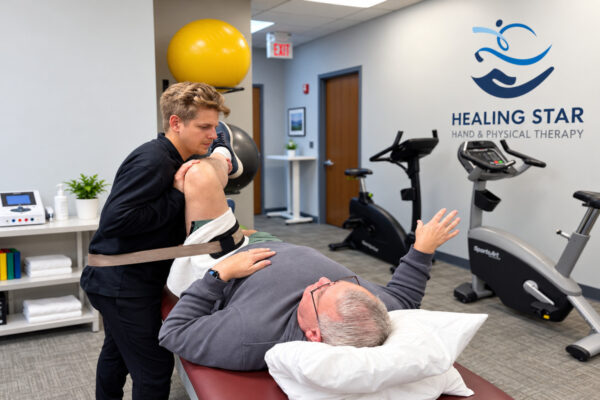
Hip evaluation includes a thorough history, observation of gait and movement, range of motion testing (including hip internal rotation — a sensitive early indicator of intra-articular pathology), strength testing of hip flexors, abductors, external rotators and extensors, FABER and FADIR impingement tests, Thomas test for hip flexor length, FAIS cluster, and lumbar spine screening to rule out referred pain. Available imaging is reviewed in clinical context.
Our Treatment Toolkit
- Manual therapy and hip joint mobilization — restoring intra-articular mobility and reducing pain
- Focused shockwave therapy — for gluteal and iliopsoas tendinopathy
- Dry needling (including ultrasound-guided) — for deep gluteals, piriformis, and iliopsoas
- BFR training — safe, effective quad and glute strengthening with minimal joint load
- Laser therapy — reducing hip joint and tendon inflammation
- IASTM and cupping — for TFL, IT band, and fascial restrictions
- Targeted hip and glute strengthening — the primary long-term treatment for most hip conditions
- Gait and movement retraining — correcting loading patterns that perpetuate hip pathology
Do I Need a Referral?
New Jersey is a direct-access state — no referral required.
Eatontown, NJ: 145 Wyckoff Rd, Suite 102 — (848) 208-2721
Freehold, NJ: 501 Iron Bridge Road, Suite 2 — (732) 272-1438
Ready to experience the Healing Star difference?
Book an appointment and take the first step toward feeling better.