

Knee Pain
From Weekend Warriors to Total Knee Replacements — Expert Knee Care
The knee is the largest joint in the body and one of the most frequently injured — bearing forces several times body weight during everyday activities and significantly more during sport and exercise. At Healing Star PT, we treat the full spectrum of knee conditions: from acute sports injuries and post-surgical rehabilitation to chronic overuse conditions and degenerative arthritis. Understanding which structure is the source of your pain — and why — is the foundation of everything we do.
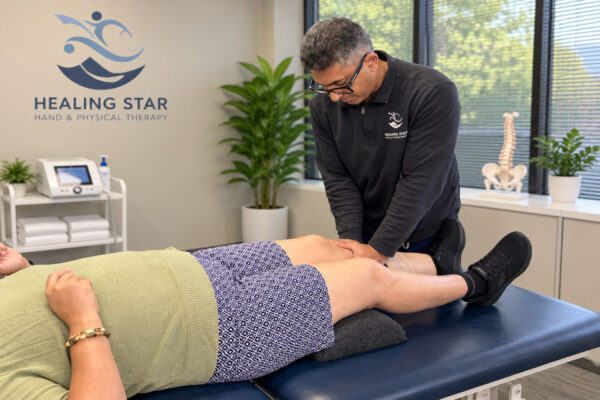
Understanding the Knee
The knee is a hinge joint formed by the femur (thigh bone), tibia (shin bone), and patella (kneecap). Stability is provided by four primary ligaments: the anterior cruciate ligament (ACL) and posterior cruciate ligament (PCL) inside the joint, and the medial collateral (MCL) and lateral collateral (LCL) ligaments on each side. Between the femur and tibia are two C-shaped cartilage discs — the medial and lateral menisci — that absorb shock and distribute load. The quadriceps and hamstrings control knee movement and provide dynamic stability; hip strength significantly influences knee mechanics from above.
Conditions We Treat
ACL Injuries
ACL tears are among the most common serious knee injuries in athletes — occurring frequently with cutting, pivoting, landing from a jump, or direct contact. The classic mechanism is a non-contact deceleration with the knee in valgus (collapsing inward). Patients often report hearing or feeling a ‘pop,’ followed by significant swelling within hours. ACL injuries are managed with either conservative rehabilitation or surgical reconstruction depending on the patient’s activity level, knee stability, and associated injuries.
At Healing Star PT we provide both prehabilitation before ACL reconstruction and comprehensive post-surgical rehabilitation following it. Blood flow restriction training is a cornerstone of our ACL rehab protocol — rebuilding quadriceps mass and strength at very low loads when full loading is still restricted in the early post-surgical phase. We use VALD HumanTrak for objective return-to-sport assessment — measuring symmetry between the surgical and non-surgical legs to determine when full return to play is truly safe.
Meniscus Injuries
Meniscus tears can occur acutely (typically from a twisting injury under load) or degeneratively (gradually in middle-aged and older adults without a specific incident). Symptoms include joint line pain (medial or lateral), swelling, catching or locking sensations, and pain with squatting or pivoting. Not all meniscus tears require surgery — research increasingly supports conservative management for many tear patterns, particularly degenerative tears in older patients. Physical therapy addresses the contributing factors (quadriceps and hip strength, gait mechanics) and allows many patients to return to full activity without surgery.
Patellofemoral Pain Syndrome — Runner’s Knee
Patellofemoral pain syndrome (PFPS) produces pain at or behind the kneecap — typically worsened by stairs, squatting, prolonged sitting, and running. It results from abnormal tracking of the patella in the femoral groove, creating excessive pressure on the cartilage surfaces. Contributing factors include weak hip abductors and external rotators (causing dynamic knee valgus), tight IT band and lateral retinaculum pulling the patella laterally, and quadriceps weakness or imbalance. PFPS is highly responsive to PT — addressing the hip and lower extremity mechanics that drive abnormal patellar tracking is more effective than knee-focused treatment alone.
Patellar Tendinopathy — Jumper’s Knee
Patellar tendinopathy affects the tendon connecting the kneecap to the tibial tubercle — the structure that transmits quadriceps force into the lower leg. It’s most common in athletes involved in jumping sports (basketball, volleyball) and presents as sharp anterior knee pain, maximal at the inferior pole of the patella, worse with jumping, landing, and descending stairs. Chronic tendinopathy involves structural disorganization of tendon collagen that does not resolve with rest — it requires progressive loading (specifically heavy slow resistance training) and focused shockwave therapy to stimulate proper tissue remodeling.
At Healing Star PT, focused shockwave therapy combined with heavy slow resistance loading is our preferred approach for patellar tendinopathy — producing excellent results even in cases that have failed other treatments for months or years.
IT Band Syndrome
IT band syndrome causes lateral knee pain from friction of the iliotibial band against the lateral femoral condyle — most commonly in runners and cyclists. Contributing factors include weak hip abductors (gluteus medius), excessive training volume, footwear, and running mechanics. Cupping and IASTM are particularly effective for addressing the IT band and lateral fascial system; dry needling targets the TFL and gluteus medius trigger points that drive IT band tension; progressive hip strengthening addresses the underlying cause.
Knee Osteoarthritis
Knee OA affects approximately 25% of adults over 55 and is characterized by cartilage loss, bone spur formation, joint space narrowing, and pain, stiffness, and decreased function. Physical therapy is one of the most strongly evidence-supported treatments for knee OA — equivalent to or better than medication for pain and function in multiple high-quality trials. The mechanism is straightforward: strong quadriceps and hip muscles dramatically reduce forces transmitted through the arthritic joint surfaces.
BFR training is particularly valuable for knee OA patients — meaningful quad strength gains at loads too low to cause joint pain, making it possible to build protective musculature even when higher-load exercise is not tolerated. Laser therapy reduces intra-articular inflammation. Manual therapy improves joint mobility and reduces pain.
Total and Partial Knee Replacement Rehabilitation
Recovery from knee replacement is highly dependent on the quality of rehabilitation. Pre-surgical PT (prehabilitation) improves post-operative outcomes — patients who arrive at surgery with better quad strength and less pain have shorter hospital stays and faster returns to function. Post-surgical rehab at Healing Star PT follows a phase-based protocol: early edema management and NMES for quadriceps re-activation, progressive range of motion restoration, graduated strengthening using BFR in early phases, and functional training toward the patient’s specific activity goals.
MCL and LCL Sprains
Collateral ligament sprains range from mild grade I stretches to complete grade III tears. The vast majority are managed conservatively with PT — even complete MCL tears typically heal without surgery. Treatment progresses from early pain and swelling management through range of motion restoration, strength rebuilding, and sport-specific functional training.
Our Assessment Process
Your evaluation includes a detailed injury history, gait observation, range of motion measurement, strength testing of the quadriceps, hamstrings, and hip musculature, ligamentous stability testing (Lachman, anterior/posterior drawer, valgus/varus stress), meniscal provocation tests, patellar mobility and tracking assessment, and lower extremity alignment analysis. We review any available imaging in the context of your clinical presentation.
Our Treatment Toolkit
- Manual therapy and joint mobilization — restoring normal knee and patellar mechanics
- BFR training — rebuilding quadriceps strength safely in early post-surgical, arthritic, or painful conditions
- Focused shockwave therapy — for tendinopathy (patellar and quadriceps) and calcific conditions
- Dry needling — for TFL, gluteus medius, quadriceps, and hamstring trigger points
- Cupping and IASTM — IT band and fascial mobility
- Laser therapy — post-surgical healing, OA inflammation, tendon recovery
- VALD HumanTrak — objective return-to-sport and symmetry assessment
- Kinesio taping — patellar tracking support and edema management
- Progressive lower extremity and hip strengthening — addressing the biomechanical root cause
Do I Need a Referral?
New Jersey is a direct-access state — no referral needed to begin physical therapy.
Eatontown, NJ: 145 Wyckoff Rd, Suite 102 — (848) 208-2721
Freehold, NJ: 501 Iron Bridge Road, Suite 2 — (732) 272-1438
Ready to experience the Healing Star difference?
Book an appointment and take the first step toward feeling better.