

Neck Pain & Headaches
Expert Hands-On Relief for Neck Pain, Stiffness, and Headaches
Neck pain is one of the most common musculoskeletal complaints in the United States — affecting roughly 30% of adults in any given year. At Healing Star PT, we understand that ‘neck pain’ is rarely one thing. Disc problems, facet joint dysfunction, muscle tension, postural strain, and nerve irritation all feel different, respond to different treatments, and require a precise clinical diagnosis to manage effectively. Our Maitland-certified manual therapists are trained to identify exactly what’s driving your symptoms — and deliver a targeted plan that addresses the source, not just the pain.
Understanding the Cervical Spine
The cervical spine consists of seven vertebrae (C1–C7) that support the weight of the head (approximately 10–12 lbs), protect the spinal cord, and allow an extraordinary range of motion in all directions. Between each vertebra is an intervertebral disc providing cushioning and shock absorption, and small facet joints on each side that guide movement and bear load. Emerging from spaces between each vertebra are nerve roots that travel into the arms — when compressed or irritated, these produce the arm pain, numbness, and tingling characteristic of cervical radiculopathy.
The neck’s mobility makes it versatile — but also vulnerable. The same freedom of movement that lets you look over your shoulder also means that prolonged poor posture, repetitive strain, or a single traumatic event can create significant dysfunction across multiple structures simultaneously.
Conditions and Causes We Treat
Cervicogenic Headaches
Cervicogenic headaches originate from dysfunction in the upper cervical spine — most commonly the C1–C3 joints, surrounding muscles, and suboccipital region. They are often mistaken for tension headaches or migraines and are significantly undertreated as a result. The key distinguishing feature: cervicogenic headaches are reproducible with neck movement or palpation of the upper cervical spine, and they refer from the neck into the head rather than beginning there.
Common patterns include pain at the base of the skull, one-sided head pain radiating from the neck to the temple or behind the eye, and headaches that worsen after sustained postures like desk work or driving. Physical therapy — specifically Maitland manual therapy targeting the upper cervical segments — is among the most effective treatments available and often produces results where medication provides only temporary relief.
Disc Herniation and Cervical Radiculopathy
A cervical disc herniation occurs when the soft inner nucleus of a disc pushes through its outer wall and contacts a nerve root in the cervical spine. Depending on the level involved, this produces characteristic patterns of arm pain, numbness, tingling, and weakness:
- C4–C5 (C5 nerve root) — shoulder pain and weakness, deltoid area numbness
- C5–C6 (C6 nerve root) — pain into the thumb and index finger, biceps weakness, lateral forearm numbness
- C6–C7 (C7 nerve root) — pain into the middle finger, triceps weakness, posterior forearm symptoms
- C7–T1 (C8 nerve root) — pain into the ring and little finger, grip weakness
Cervical radiculopathy is highly treatable with conservative physical therapy. Manual therapy, mechanical cervical traction, and neural mobilization reduce compression on the nerve root and allow the disc material to resolve. Most patients improve significantly without surgery.
Postural Dysfunction and Forward Head Posture
For every inch the head translates forward from its neutral position over the shoulders, the effective weight on the cervical spine increases by approximately 10 lbs. At a 45-degree forward position (common with phone use), the neck is managing the equivalent of 49 lbs of load. Over time, this creates chronic compressive stress on the lower cervical joints and discs, sustained stretch on the posterior cervical muscles, and shortening of the anterior structures. The result is the characteristic pattern of lower cervical pain, upper trapezius tightness, and cervicogenic headaches that has become epidemic with modern technology use.
Forward head posture is not just a habit — it’s a structural problem that responds well to targeted manual therapy, deep neck flexor strengthening, and postural retraining at Healing Star PT.
Facet Joint Syndrome
The cervical facet joints are small, paired joints on either side of the spine that guide movement and bear significant compressive load. Facet joint syndrome occurs when these joints become irritated or inflamed from degenerative change, acute injury (including whiplash), or sustained poor posture. It typically produces localized neck pain and stiffness that is worse in the morning, reproduced with extension and rotation, and relieved by movement. Maitland manual therapy — specifically targeted joint mobilization and manipulation — is highly effective for facet-mediated pain.
Whiplash and Cervical Strain
Whiplash injuries most commonly result from rear-end motor vehicle collisions, where the head undergoes rapid forced extension followed by flexion. This can simultaneously injure muscles, ligaments, facet joints, discs, and nerve roots — explaining why whiplash can produce such a wide and confusing constellation of symptoms: neck pain and stiffness, headaches, shoulder and arm pain, dizziness, jaw pain, and difficulty concentrating.
Early physical therapy is critical for optimal recovery. Prolonged immobilization or avoidance of movement is associated with worse outcomes. Our therapists address all components of the whiplash injury simultaneously — manual therapy for joint and soft tissue dysfunction, dry needling for muscle guarding and trigger points, mechanical traction if discogenic or radicular symptoms are present, and progressive cervical strengthening.
Degenerative Disc Disease and Cervical Spondylosis
Cervical spondylosis is a broad term for age-related degenerative changes in the cervical spine — disc narrowing, bone spur formation, and facet joint arthritic change. The presence of degenerative changes on imaging does not automatically mean these changes are causing your pain. Many people have significant degenerative findings with no symptoms at all. Our job is to identify the symptomatic structures and treat them effectively — reducing pain, improving mobility, and building the muscular support that protects your spine long term.
Our Assessment Process
Your initial evaluation includes a detailed history, postural assessment, cervical range of motion measurement, segmental mobility testing of each cervical level, neurological screening for nerve involvement (reflexes, sensation, strength), and orthopedic special tests. Where appropriate, we review any imaging you’ve brought. This comprehensive picture allows your therapist to identify precisely which structures are involved and design a targeted plan.
Our Treatment Approach
Maitland Manual Therapy
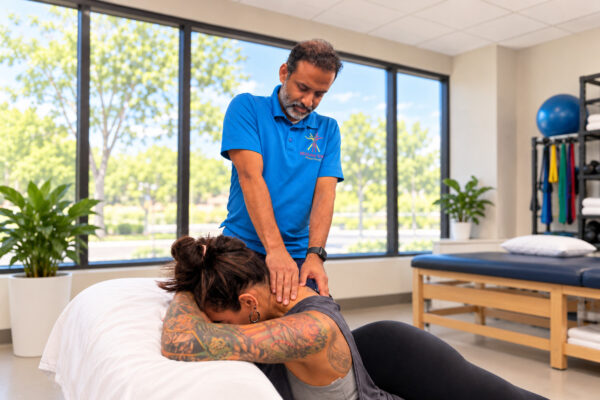
Segmental joint mobilization and manipulation targeting the specific cervical levels identified as the source of symptoms. Our therapists hold the COMT (Certified Orthopaedic Manual Therapist) certification — one of the most rigorous manual therapy credentials available.
Dry Needling with E-Stim
Highly effective for the upper trapezius, levator scapulae, suboccipital, and deep cervical multifidus trigger points that contribute to neck pain and headaches. E-stim through the needle enhances relaxation and reduces post-treatment soreness.
Mechanical Cervical Traction
Delivers a precise distraction force to the cervical spine, reducing disc pressure and nerve root compression. Particularly effective for disc herniation, radiculopathy, and foraminal stenosis. Most patients experience significant arm symptom relief in the first 1–3 sessions.
Class IV Laser Therapy
Reduces inflammation in facet joints, disc tissue, and nerve roots, accelerating the healing process for both acute and chronic cervical conditions.
Deep Neck Flexor Strengthening
The longus colli and longus capitis muscles are the deep stabilizers of the cervical spine — analogous to the core for the lumbar spine. In the vast majority of chronic neck pain and cervicogenic headache patients these muscles are inhibited and atrophied. Targeted reactivation is fundamental to lasting results.
Postural Correction and Ergonomics
Sustained postural loads are often the primary perpetuating factor for neck pain. We provide individualized guidance on workstation setup, phone and tablet habits, driving posture, and sleeping position.
Do I Need a Referral?
New Jersey is a direct-access state — you can begin physical therapy without a physician’s referral.
How Long Will Recovery Take?
Acute neck pain and cervicogenic headaches often improve significantly within 4–6 sessions. Disc herniation with radiculopathy typically requires 8–12 sessions over 4–6 weeks, with most patients experiencing meaningful arm symptom relief within the first 2–3 weeks. Chronic or degenerative conditions benefit from a longer course focused on progressive strengthening and self-management strategies. You will always receive an honest timeline estimate at your initial evaluation.
Ready to experience the Healing Star difference?
Book an appointment and take the first step toward feeling better.