

Elbow, Wrist & Hand Pain
Expert Upper Extremity Care — From Tennis Elbow to Post-Surgical Hand Therapy
The elbow, wrist, and hand are among the most complex and functionally critical structures in the body. Even minor loss of hand function has an outsized impact on daily life — affecting everything from work to self-care to the activities you love. At Healing Star PT, we are proud to offer the expertise of a Certified Hand Therapist (CHT) — a specialized credential held by fewer than 10% of occupational and physical therapists, representing the highest level of clinical competence in upper extremity rehabilitation.
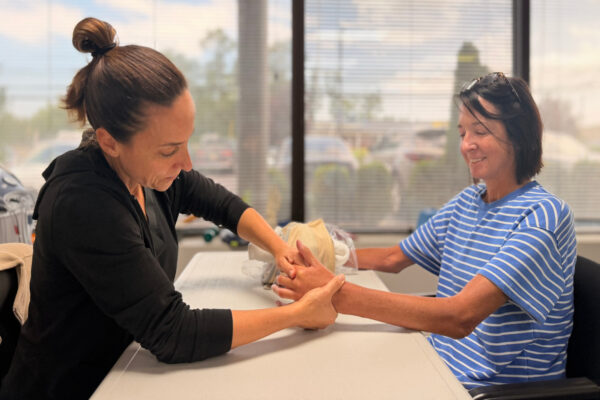
Our Certified Hand Therapist
Allisen Ayuso, OTR/L, CHT is a Certified Hand Therapist with specialized expertise in all conditions of the elbow, wrist, and hand — from conservative treatment of tendinopathy and nerve compression to complex post-surgical rehabilitation and custom splinting.
Conditions We Treat
Tennis Elbow — Lateral Epicondylitis
Tennis elbow is the most common elbow condition treated in outpatient PT — affecting up to 3% of adults per year, the majority of whom have never held a tennis racket. It produces pain and tenderness at the lateral epicondyle (outer bony prominence of the elbow), with pain reproduced by gripping, lifting, turning a doorknob, or extending the wrist against resistance. Despite the name ‘epicondylitis,’ research shows that the pathology is tendinopathic — degenerative change in the common extensor tendon — rather than inflammatory. This means anti-inflammatory treatments (ice, NSAIDs, cortisone) have limited long-term effectiveness.
At Healing Star PT, we treat lateral epicondylitis with focused shockwave therapy to stimulate tendon remodeling, progressive wrist and forearm loading exercise, IASTM for soft tissue mobilization, dry needling, and activity modification guidance. This combination produces excellent outcomes even in cases that have failed injections and other conservative measures.
Golfer’s Elbow — Medial Epicondylitis
Medial epicondylitis affects the common flexor-pronator tendon at the medial epicondyle (inner elbow) — producing pain with gripping, wrist flexion, and forearm pronation. It is common in golfers, baseball pitchers, racquet sport players, and manual laborers. Like lateral epicondylitis, it is tendinopathic rather than inflammatory, and is treated most effectively with progressive loading exercise, focused shockwave, and dry needling. The ulnar nerve runs in close proximity to the medial epicondyle — we always screen for cubital tunnel involvement (inner elbow nerve compression) in medial epicondylitis patients.
Carpal Tunnel Syndrome
Carpal tunnel syndrome (CTS) is the most common peripheral nerve compression syndrome, affecting approximately 3–6% of the general population. The median nerve is compressed as it passes through the carpal tunnel — a narrow passageway at the base of the wrist. Symptoms include numbness, tingling, and pain in the thumb, index, middle, and half of the ring finger — classically worse at night and with sustained wrist positions (driving, holding a phone, typing). Thenar muscle weakness and atrophy indicate more severe compression.
Physical therapy manages mild to moderate CTS effectively: nerve mobilization (neural flossing), carpal bone mobilization, activity and ergonomic modification, custom splinting to maintain neutral wrist position during sleep, and postural correction of the neck and shoulder to address proximal neurodynamic tension. Our MSK diagnostic ultrasound can visualize the median nerve at the wrist, confirming the diagnosis by measuring nerve cross-sectional area without a referral for electrodiagnostic testing.
Cubital Tunnel Syndrome — Ulnar Nerve Compression at the Elbow
The ulnar nerve passes behind the medial epicondyle of the elbow through the cubital tunnel. Compression here produces numbness and tingling in the ring and little fingers, inner forearm symptoms, and — in advanced cases — intrinsic hand muscle weakness and clawing. It is aggravated by prolonged elbow flexion (sleeping with the arm bent, holding a phone). PT includes nerve mobilization, activity modification, custom elbow splinting to prevent sustained flexion, and postural retraining.
Trigger Finger — Stenosing Tenosynovitis
Trigger finger occurs when inflammation and swelling of the flexor tendon sheath creates a discrepancy between the tendon and the A1 pulley through which it runs — producing catching, clicking, or locking of the finger in flexion. It is most common in the ring and middle fingers and in diabetic and rheumatoid arthritis patients. Conservative management includes IASTM along the flexor tendon sheath, tendon gliding exercises, activity modification, and — when indicated — coordination with your physician for corticosteroid injection before considering surgical release.
De Quervain’s Tenosynovitis
De Quervain’s affects the abductor pollicis longus and extensor pollicis brevis tendons at the radial styloid (base of the thumb / outer wrist). It produces pain and swelling at the base of the thumb, reproduced with the Finkelstein test (thumb tucked, wrist ulnar deviated). It is common in new mothers from sustained infant-carrying positions and in racquet sport and golf players. Custom thumb spica splinting from our CHT, IASTM, and activity modification are the cornerstones of conservative management.
TFCC Injuries — Triangular Fibrocartilage Complex
The TFCC is a complex of cartilage and ligaments at the ulnar side of the wrist, stabilizing the distal radioulnar joint and cushioning the wrist in rotation. Tears occur from falls on an outstretched hand, forceful forearm rotation, or repetitive loading. Ulnar-sided wrist pain, weakness with grip and rotation, and clicking with forearm turning are the typical presentation. PT addresses joint stabilization, progressive grip and forearm strength, and — for post-surgical TFCC repair — a structured return to loading protocol.
Dupuytren’s Contracture
Dupuytren’s disease involves progressive fibrosis of the palmar fascia, producing nodules and cords in the palm that can eventually pull the fingers into a fixed flexion contracture. Physical therapy — stretching, soft tissue mobilization, and custom extension splinting — helps manage the early and post-interventional stages. Following needle fasciotomy or collagenase injection, hand therapy is essential to maintain correction and prevent recurrence.
Wrist Sprains and Fracture Rehabilitation
Distal radius fractures (Colles’ and Smith’s fractures) and scaphoid fractures are among the most common fractures treated. Following casting or surgical fixation, hand therapy is the primary driver of functional recovery — restoring wrist range of motion, grip strength, and fine motor function through a structured protocol of joint mobilization, scar management, progressive strengthening, and custom splinting.
Rheumatoid Arthritis — Hand and Wrist Management
RA frequently affects the small joints of the hands and wrists — producing pain, swelling, morning stiffness, and progressive deformity. Our CHT provides specialized RA hand management: joint protection education and energy conservation strategies, custom resting and functional splints to prevent deformity and manage pain during flares, scar and edema management, and progressive exercise carefully calibrated to disease activity.
Custom Splinting
Our Certified Hand Therapist fabricates custom thermoplastic splints for a wide range of conditions — custom-molded to your anatomy, designed for your specific functional needs, and adjusted throughout your recovery as your condition changes. This capability sets us apart from standard PT practices and produces significantly better outcomes for complex upper extremity conditions.
Our Treatment Toolkit
- IASTM — tendon and soft tissue mobilization along the forearm, wrist, and hand
- Focused shockwave therapy — for lateral and medial epicondylitis
- Dry needling — forearm flexor and extensor trigger points
- Laser therapy — reduce inflammation in tendon sheaths, joints, and nerve tissue
- MSK diagnostic ultrasound — visualize tendons, median and ulnar nerve, TFCC
- Custom splinting (CHT) — thermoplastic resting, functional, and dynamic splints
- Nerve mobilization — carpal tunnel and cubital tunnel neural flossing
- Progressive grip and forearm strengthening — structured loading protocols
- Joint mobilization — wrist, carpal, and finger joint mobility restoration
Do I Need a Referral?
New Jersey is a direct-access state — no referral required. We also accept workers’ compensation and motor vehicle accident cases and coordinate directly with adjusters and case managers.
Eatontown, NJ: 145 Wyckoff Rd, Suite 102 — (848) 208-2721
Freehold, NJ: 501 Iron Bridge Road, Suite 2 — (732) 272-1438
Ready to experience the Healing Star difference?
Book an appointment and take the first step toward feeling better.