

TMJ Disorders
Jaw Pain, Headaches, and Clicking — Hands-On TMJ Treatment Without Medication
Temporomandibular disorders (TMD) are a group of conditions affecting the jaw joint, jaw muscles, and associated structures — and they are far more common than most people realize. Approximately 10–15% of adults have symptomatic TMD at any given time, yet many go undiagnosed for years, cycling through treatments for ‘tension headaches’ or ‘ear infections’ that never address the actual source. Physical therapy is one of the most effective treatments for TMD — and at Healing Star PT, we have the specialized training and techniques to treat it properly.
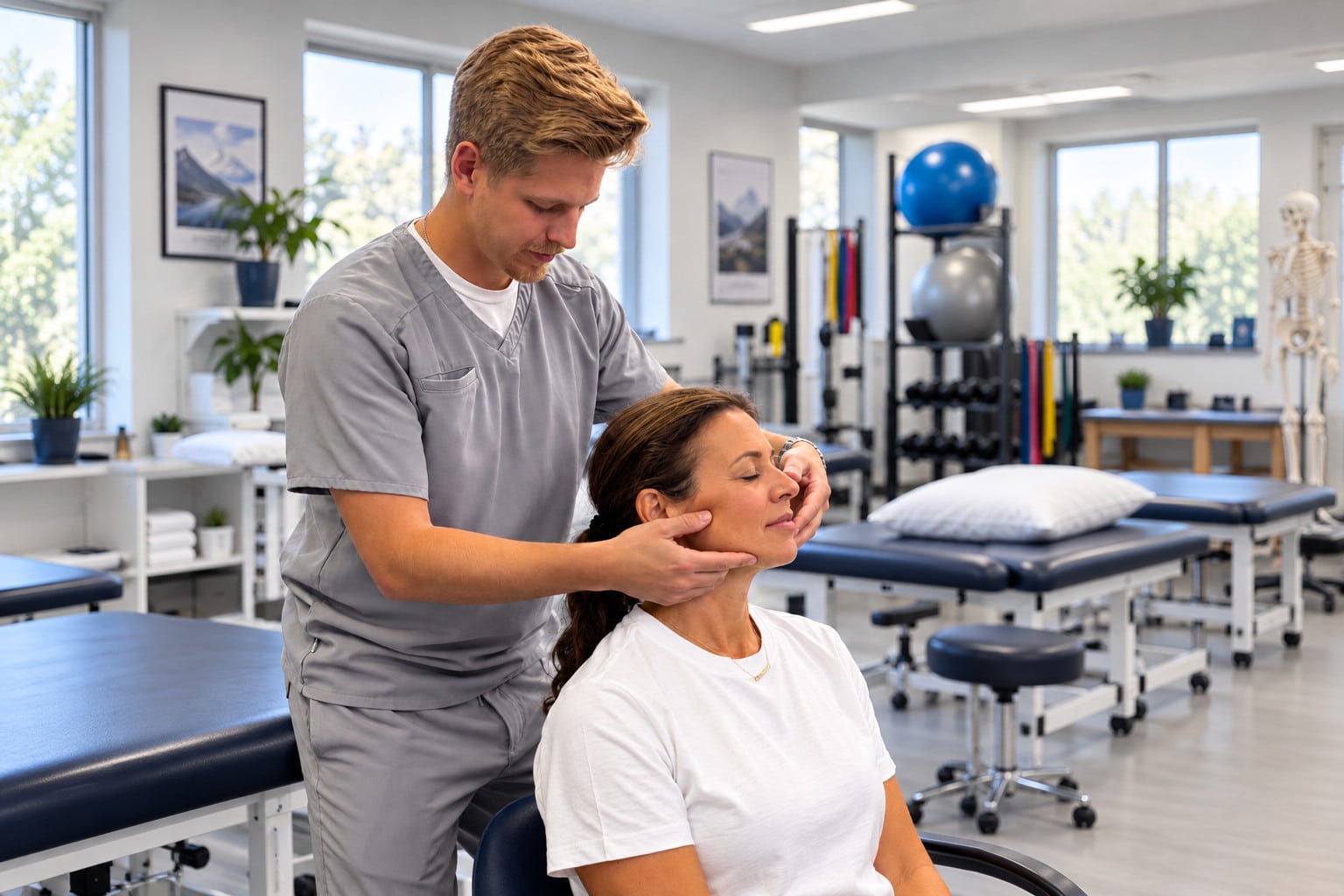
Understanding the TMJ
The temporomandibular joint is the hinge connecting the lower jaw (mandible) to the temporal bone of the skull, just in front of each ear. Between the two bony surfaces sits an articular disc that cushions movement and allows the complex motions of the jaw — opening, closing, side-to-side, and protrusion. The joint is powered by the muscles of mastication: the masseter, temporalis, medial pterygoid, and lateral pterygoid. The TMJ is unique in having two joints that must move in precise coordination — any asymmetry, disc displacement, or muscular imbalance produces dysfunction in both.
The TMJ also has a close anatomical and neurological relationship with the upper cervical spine. The trigeminal nerve — which innervates the jaw and face — converges at the same brainstem nucleus as the C1–C3 cervical nerves. This explains why upper cervical dysfunction commonly contributes to jaw pain and headaches, and why treating the neck is often an essential component of TMD rehabilitation.
Types of TMJ Disorders
Myofascial TMD — Muscle-Based Jaw Pain
Myofascial TMD is the most common type — involving pain and dysfunction primarily from the jaw muscles rather than the joint itself. The masseter and medial pterygoid become overloaded from bruxism (teeth clenching and grinding), stress-related jaw tension, dental malocclusion, or prolonged unilateral chewing. The result is a network of active trigger points in the jaw muscles that produce local jaw pain and refer pain to the temple, cheek, teeth, ear, and base of the skull.
Trigger points in the lateral pterygoid — a deep muscle accessible only intraorally — are particularly important in TMD and headache referral patterns. Our therapists are trained in intraoral manual therapy and intraoral dry needling to address these deep structures directly.
Disc Displacement — Articular TMD
The articular disc can displace from its normal position on top of the condyle — most commonly displacing anteriorly. Disc displacement with reduction produces the classic clicking or popping when opening or closing the mouth, as the condyle clicks over the displaced disc and then reduces under it during movement. Disc displacement without reduction removes the clicking but causes limited jaw opening and pain — the disc is blocking condylar translation. Manual therapy techniques specifically aimed at restoring normal disc-condyle mechanics can reduce or eliminate clicking and restore normal opening range in many patients.
Bruxism and Clenching
Bruxism — involuntary teeth grinding or jaw clenching — places extreme loads on the TMJ, disc, and jaw muscles, often occurring during sleep when there is no conscious inhibition. Daytime clenching under stress is also extremely common. The resulting muscle hypertrophy, trigger point formation, and joint loading contribute to pain, morning stiffness, headaches, tooth wear, and jaw fatigue. PT addresses the muscular consequences of bruxism; we coordinate with dentists for nightguard fabrication when appropriate.
Osteoarthritis of the TMJ
Degenerative arthritis in the TMJ produces joint pain, crepitus (grinding/crackling) with movement, morning stiffness, and progressive changes on imaging. It is managed with a combination of joint mobilization, pain-free movement within available range, laser therapy to reduce intra-articular inflammation, and jaw muscle rebalancing.
The temporomandibular joint connects your lower jaw (mandible) to your skull, just in front of each ear. It functions like a sliding hinge, allowing you to open and close your mouth and move your jaw side to side. A small disc of cartilage sits between the bones to cushion movement and keep things gliding smoothly.
When the joint, the disc, or the surrounding muscles become irritated, inflamed, or misaligned, it’s referred to as a temporomandibular disorder — or TMD/TMJ disorder.
Symptoms We Treat
- Jaw pain or soreness — often worse in the morning from overnight clenching
- Clicking, popping, or grinding sounds with jaw movement
- Limited jaw opening or locking
- Headaches — at the temples, behind the eyes, or at the base of the skull
- Facial pain and cheek tenderness
- Ear pain, fullness, or ringing (tinnitus) without ear infection
- Neck and shoulder pain co-occurring with jaw symptoms
- Tooth sensitivity or pain without dental cause
- Pain with chewing, yawning, or speaking
The Neck–Jaw Connection
This is one of the most important and most overlooked aspects of TMD: the cervical spine and the jaw do not operate independently. Forward head posture increases the mechanical demand on the jaw muscles, as the mandible must work against gravity to maintain occlusion. Upper cervical joint dysfunction sends sensory input into the same brainstem nucleus as the TMJ and jaw muscles — creating cross-sensitization that amplifies both jaw and head pain. Chronic neck tension perpetuates jaw muscle hyperactivity through shared motor patterns.
Effective TMD physical therapy must address both the jaw and the cervical spine. Patients who receive only jaw-focused treatment frequently relapse because the cervical drivers are never addressed. Our integrated approach evaluates and treats both regions within a single program.
Many patients come to Healing Star PT for neck pain or cervicogenic headaches and discover their jaw is a contributing factor they were unaware of — and vice versa. Our comprehensive evaluation ensures nothing is missed.
Our Assessment Process
TMD evaluation includes a detailed symptom history (onset, triggers, sleep patterns, stress, dental history), jaw opening range of motion measurement (normal is 40–55mm), symmetry of opening path, quality and timing of joint sounds, palpation of the masseter, temporalis, and accessible pterygoid musculature, and cervical spine examination. We assess the relationship between cervical positioning and jaw symptoms to identify the degree of cervical contribution.
Our Treatment Approach
Intraoral Manual Therapy
With gloves, your therapist directly mobilizes the temporomandibular joint and releases tension in the medial pterygoid muscle — the only effective way to access this important deep jaw muscle. Intraoral techniques restore normal disc-condyle mechanics, improve opening range, and reduce joint pain far more effectively than extraoral treatment alone.
Dry Needling — Extraoral and Intraoral
Dry needling to the masseter, temporalis, and suboccipital muscles eliminates trigger points responsible for jaw pain and headache referral. E-stim through the needle enhances relaxation of chronically hypertonic jaw muscles. Intraoral needling to the medial pterygoid is reserved for specific cases and performed by trained clinicians.
Upper Cervical Manual Therapy
Maitland mobilization targeted at C1–C3 reduces upper cervical joint dysfunction contributing to headaches and jaw pain. In many patients, successful cervical treatment produces immediate reduction in jaw symptoms — confirming the cervico-mandibular relationship.
Laser Therapy
Low-level laser applied over the joint and masseter reduces intra-articular and muscular inflammation. Particularly useful for acute flares and post-surgical TMJ cases.
Jaw Exercise and Neuromuscular Retraining
Coordinated jaw opening and closing exercises retrain normal movement patterns, restore symmetrical disc-condyle mechanics, and reduce muscle guarding. Postural exercises address the cervical and scapular patterns that contribute to jaw dysfunction.
Bruxism and Stress Management Education
Understanding the connection between stress, jaw habits, and symptoms empowers patients to manage perpetuating factors. We provide a structured awareness and habit-change program for daytime clenching.
Interdisciplinary Coordination
We collaborate with your dentist, orthodontist, or oral and maxillofacial surgeon when appropriate — sharing clinical findings to inform nightguard fabrication, occlusal adjustments, or surgical planning. TMD is a shared condition that benefits from a team approach.
What Results Can I Expect?
Myofascial TMD — the most common type — typically shows significant improvement within 4–8 sessions. Disc displacement with reduction (clicking) often responds within 6–10 sessions. Patients with significant cervical contributions frequently notice headache reduction within the first 2–3 cervical treatment sessions. We will provide a realistic estimate and measurable goals at your initial evaluation. Most patients treated at Healing Star PT experience meaningful, lasting improvement — many having previously tried other approaches without success.
Do I Need a Referral?
New Jersey is a direct-access state — no referral from a dentist or physician is required.
Eatontown, NJ: 145 Wyckoff Rd, Suite 102 — (848) 208-2721
Freehold, NJ: 501 Iron Bridge Road, Suite 2 — (732) 272-1438
Ready to experience the Healing Star difference?
Book an appointment and take the first step toward feeling better.