

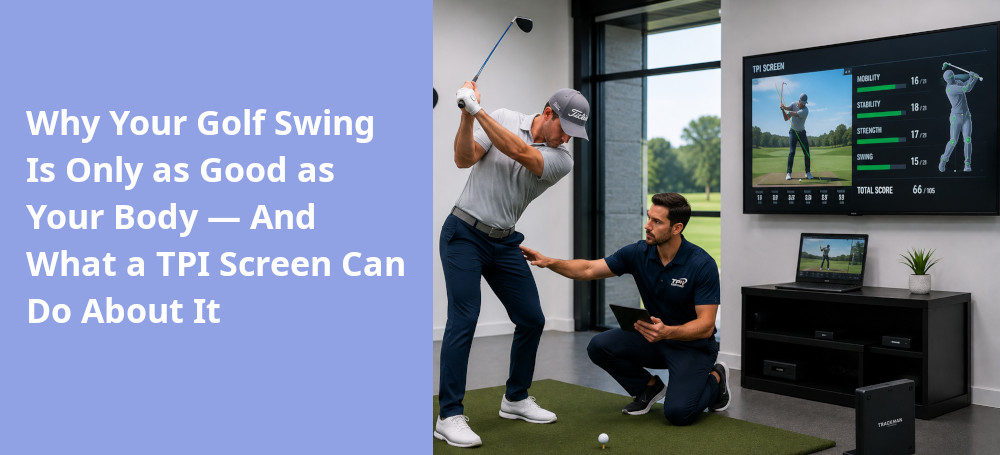
It’s mid-October. The leaves are turning, the courses in Monmouth County are emptying out, and if you’re a golfer, you’re probably thinking about one of two things: either the rounds you lost to a bad back, a stiff hip, or that persistent elbow pain — or the 10 yards of distance you couldn’t quite find no matter what you tried.
Here’s something most golfers don’t realize: those two problems — the pain and the performance — are almost always the same problem. And the fix isn’t a new driver, a swing lesson, or another YouTube tutorial. It’s your body.
At Healing Star Physical Therapy, we’re now offering TPI Golf Performance Screens — a comprehensive physical assessment developed by the Titleist Performance Institute that connects what your body can and can’t do directly to what shows up in your swing. The off-season is the perfect time to address the physical limitations that cost you shots this year — so you show up to the first tee next spring in the best shape of your golfing life.
The Body-Swing Connection: What TPI Research Found
TPI — the Titleist Performance Institute — has assessed over 50,000 golfers at every level, from weekend players to PGA Tour professionals. Their research produced one of the most important findings in golf instruction: swing faults aren’t primarily caused by poor technique. They’re caused by physical limitations.
In other words, a golfer who comes over the top on their downswing, loses their posture at impact, or can’t complete their follow-through often isn’t doing it because they haven’t practiced enough. They’re doing it because their body physically cannot move the way a good swing requires — and the swing is compensating the only way it can.
“We don’t teach the golf swing. We identify what the body can and can’t do — and then remove the physical barriers that are getting in the way.”
This is the core of the TPI philosophy, and it’s why so many tour-level players have TPI-certified practitioners as a regular part of their performance team.
What the Screen Actually Looks At
The TPI Golf Performance Screen is a 16-point physical assessment that evaluates the mobility, stability, and coordination of every major body region involved in the golf swing. It takes about 45–60 minutes and requires no special equipment — just you, your body, and a TPI-certified physical therapist.
We assess:
- Thoracic (mid-back) rotation — arguably the single most important physical factor in golf. Limited thoracic mobility forces the lower body to compensate, robbing you of power and placing stress on the lumbar spine.
- Hip mobility and rotation — the hips are the engine of the swing. Restricted hip rotation leads to early extension, swaying, and the dreaded ‘slide’ through impact.
- Shoulder mobility — limited shoulder mobility affects the backswing, shoulder plane, and the ability to achieve a proper follow-through.
- Core stability and control — a stable core is the link between the lower and upper body. Without it, power generated by the legs and hips leaks before it reaches the club.
- Ankle dorsiflexion — yes, your ankles matter. Limited ankle mobility causes loss of posture and balance issues that ripple all the way up the kinetic chain.
- Single-leg balance and stability — the golf swing happens on one leg. If you can’t balance there under load, your swing will show it.
- Pelvic mobility and dissociation — the ability to move the pelvis independently of the upper body is essential for sequencing power and protecting the spine.
What Common Swing Faults Actually Mean Physically
One of the most useful things a TPI screen reveals is that your swing faults have a physical explanation — and knowing that explanation is the first step toward fixing it. Here are some of the most common connections:
Loss of posture / early extension
You start in a good athletic position but stand up through impact, causing the club to come in steep or making consistent contact difficult. Physical cause: limited hip mobility or weak glutes force the body to extend early to make room for the arms to swing through.
Over-the-top / slice
The club comes from outside the target line on the downswing. Physical cause: limited thoracic rotation means the upper body can’t rotate back far enough, so the arms dominate the downswing and pull the club outside-in.
Reverse spine angle
The spine tilts toward the target at the top of the backswing — a significant predictor of lower back injury. Physical cause: restricted lead hip mobility or limited thoracic rotation forces the spine to compensate by tilting.
Flat shoulder plane / hanging back
The trail shoulder works too low in the downswing, causing the club to approach from too far inside. Physical cause: limited shoulder mobility, lat tightness, or poor thoracic extension restricts the ability to get the lead shoulder under the chin in the backswing.
Sway and slide
Excessive lateral movement of the hips during the backswing or downswing. Physical cause: limited hip internal rotation on the trail side makes it difficult to load the hip properly, causing the body to sway instead of turn.
Golf Injuries We See — and Treat — at Healing Star PT
The off-season is also the right time to address any injuries that accumulated during the season. Golf injuries are almost never random — they’re the predictable result of a body under repeated mechanical stress it wasn’t physically prepared to handle. The most common ones we see:
- Low back pain — the leading cause of lost rounds among amateur golfers. Disc injuries, facet joint irritation, and muscle strain all commonly develop from poor mechanics under physical limitation.
- Golfer’s elbow (medial epicondylitis) — inner elbow pain from grip and impact forces, often worsened by compensatory swing patterns.
- Rotator cuff strain — particularly in the lead shoulder, from trail arm-dominant swings that load the lead shoulder at impact.
- Hip pain — gluteal tendinopathy and hip labral irritation from repeated rotational stress on a restricted hip.
- Wrist tendinopathy — from impact forces concentrated in the wrists when the larger muscles of the core and hips aren’t generating and transferring power efficiently.
- Knee pain — particularly in the lead knee from the rotational and compressive forces of the downswing and follow-through.
We treat all of these conditions with our full toolkit — manual therapy, dry needling, focused shockwave therapy, laser therapy, and targeted rehabilitation — while simultaneously addressing the swing mechanics and physical limitations that caused them.
What You Get from a TPI Screen at Healing Star PT
After your screen, you receive a detailed written report that includes:
- A summary of your physical findings — what’s mobile, what’s restricted, what’s strong, and what needs work
- The specific swing faults most likely associated with each finding
- A targeted physical therapy or home exercise program addressing your specific limitations
- Guidance on coordinating your physical work with your golf instruction (we’re happy to communicate with your teaching pro)
- A clear plan for the off-season — so you arrive at the first tee next spring moving better than you have in years
The Off-Season Advantage
Most golfers spend the off-season doing nothing — and show up to the range in April with the same limitations they ended the season with. The golfers who use the winter to address their physical restrictions show up to the first round noticeably different: more range of motion, more power, better sequencing, and less pain.
Three to four months of targeted physical work between now and April is genuinely enough time to make meaningful changes in thoracic rotation, hip mobility, core stability, and shoulder mobility — the four physical factors that matter most in golf. We’ve seen patients gain significant distance, improve consistency, and play pain-free after addressing limitations that had been holding them back for years.
Who Should Get a TPI Screen?
- Golfers dealing with back, hip, shoulder, elbow, or wrist pain during or after rounds
- Anyone who wants to improve distance, consistency, or ball striking
- Players who’ve been told their swing fault is a technique problem but haven’t fixed it with lessons
- Junior golfers building their game on a physically sound foundation
- Golfers returning from any injury who want to safely get back to full play
- Anyone who simply wants to know how their body is moving and where the weak links are
You don’t have to be a serious golfer to benefit from a TPI screen. If you play golf and your body is limiting your game or causing you pain, this assessment was designed for you.
Schedule Your TPI Golf Performance Screen
TPI Golf Performance Screens are now available at both our Eatontown and Freehold, NJ locations. The off-season is the ideal time — address what’s been holding you back so you’re ready to go when the season opens.
New Jersey is a direct-access state — no referral needed. Call either location to schedule your screen, or request an appointment online.
Eatontown, NJ: 145 Wyckoff Rd, Suite 102 — (848) 208-2721
Freehold, NJ: 501 Iron Bridge Road, Suite 2 — (732) 272-1438
Leave A Comment