

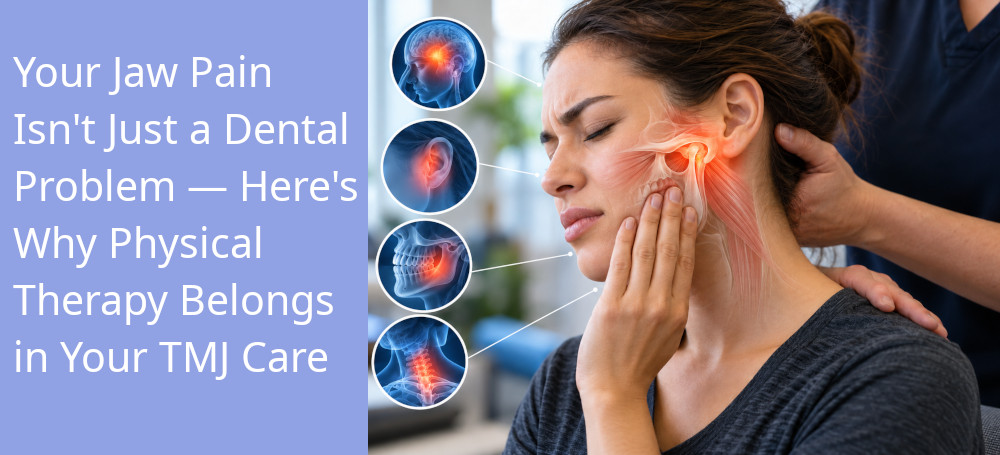
You wake up with a sore jaw. Your temples ache. You notice a clicking sound every time you open your mouth wide enough to take a bite. Your dentist tells you it’s your TMJ, fits you for a nightguard, and sends you home.
Months pass. The nightguard helps a little with the clenching — but the jaw pain is still there. The headaches keep coming. You still can’t open your mouth all the way without pain or clicking. You go back to the dentist, who shrugs and says, ‘Keep wearing the guard.’
This is one of the most common stories we hear from TMJ patients at Healing Star Physical Therapy. And there’s a reason the nightguard alone isn’t enough: jaw pain, clicking, and TMJ-related headaches are not purely a dental problem. They’re a musculoskeletal problem — which means physical therapy isn’t a last resort. It’s where a significant portion of your treatment should have started.
What Is TMJ Disorder — Really?
The temporomandibular joint is the hinge connecting your lower jaw to your skull, just in front of your ears. You have one on each side, and together they have to move in perfect coordination for every bite, word, and yawn. Between the bony surfaces of each joint sits a small articular disc that cushions and guides movement. Surrounding the joint are the muscles of mastication — the masseter, temporalis, and pterygoids — which generate the biting and chewing forces that can exceed 150 lbs per square inch.
Temporomandibular disorder (TMD) is an umbrella term for dysfunction in any of these components — the joint itself, the disc, the muscles, or the nerves associated with them. And that distinction matters, because not all TMD is the same:
- Myofascial TMD — pain primarily from the jaw muscles, driven by tension, overuse, and trigger points. The most common type.
- Articular TMD — dysfunction within the joint itself, including disc displacement (which causes clicking and limited opening) and degenerative joint changes.
- Mixed TMD — a combination of muscular and joint problems, which is actually the most common presentation in patients who’ve been symptomatic for a long time.
The reason this distinction matters: a nightguard primarily addresses articular loading — the compressive forces on the joint during clenching. It does almost nothing for trigger points in the jaw muscles, disc displacement mechanics, or the cervical spine dysfunction that is present in the majority of chronic TMD patients. To treat those things, you need hands-on care.
The Symptom No One Connects to the Jaw
Ask most people with TMD what their symptoms are and they’ll tell you: jaw pain, clicking, and maybe some difficulty chewing. But the full symptom picture of TMD is often much broader — and many patients have been treating individual symptoms for years without realizing they all have the same source.
If you have unexplained headaches, ear pain without infection, tinnitus, neck pain, facial pain, or tooth sensitivity with no dental cause — your TMJ may be involved.
Here’s why the symptom list is so extensive: the trigeminal nerve — the primary sensory nerve of the face and jaw — is the most complex cranial nerve in the body. It innervates the jaw, teeth, gums, sinuses, temples, and part of the ear canal. When the structures the trigeminal nerve serves become sensitized or dysfunctional, pain can appear anywhere in its territory. This is why a trigger point in the masseter can produce what feels like a toothache. It’s why TMJ inflammation can produce ear pain or fullness. It’s why the temporalis muscle — your temple — produces headaches that get diagnosed and treated as migraines for years.
We regularly see patients at Healing Star PT who have been to ENTs for their ear pain, neurologists for their headaches, and dentists for their tooth sensitivity — all coming back with no clear cause — and find that every symptom traces back to a jaw that hasn’t been properly evaluated or treated.
Why Your Neck Is Part of This
This is the piece that even many clinicians miss: the jaw and the neck are neurologically and mechanically linked in ways that make it impossible to fully treat one without addressing the other.
At the level of the brainstem, the trigeminal nerve — which serves the jaw — converges with the upper cervical nerves (C1–C3) in a structure called the trigeminocervical nucleus. This shared processing center means that pain signals from the neck can be perceived in the jaw, face, and head — and pain signals from the jaw can be perceived in the neck. It’s the same neurological mechanism that makes a heart attack produce arm pain: convergence of signals at a shared processing center.
The mechanical connection is equally important. Forward head posture — which affects the majority of people who work at desks, drive frequently, or spend significant time on their phones — shifts the lower jaw backward and downward relative to neutral. The jaw muscles must work harder to maintain bite position against gravity. Over time, this chronic overload of the masseter and pterygoids creates exactly the muscle tension and trigger points that produce TMD symptoms.
In a 2020 systematic review, cervical spine dysfunction was present in over 70% of chronic TMD patients. Treating the neck — not just the jaw — is essential for lasting TMD recovery.
At Healing Star PT, every TMD patient receives a cervical spine examination as part of their initial evaluation. In many patients, treating the upper cervical spine produces immediate reductions in jaw pain and headaches — confirming the cervical contribution that would have been missed with jaw-only treatment.
What Physical Therapy Actually Does for TMJ
Physical therapy for TMD is not exercises you can look up on YouTube. It is skilled, hands-on clinical care targeted at specific tissues — and it includes techniques that cannot be replicated at home.
Intraoral Manual Therapy
The medial and lateral pterygoid muscles are the deep inner jaw muscles that generate chewing force and control jaw position. They are impossible to reach adequately from the outside. With gloves on, a trained PT can directly palpate, mobilize, and treat these muscles from inside the mouth — releasing the trigger points and muscle guarding that drive a significant portion of TMD pain and limited opening. This is one of the most clinically powerful TMD techniques available, and it’s not something a dentist, a massage therapist, or a YouTube exercise can deliver.
TMJ Joint Mobilization
When the articular disc has displaced — which is what causes the clicking or the limited opening that comes on suddenly — specific manual therapy techniques can restore the normal relationship between the disc and the condyle. Your therapist applies precisely controlled forces to the jaw joint in directions that encourage the disc to recapture its normal position. For patients with disc displacement with reduction (clicking), this approach frequently reduces or eliminates the sound and restores fuller, more comfortable jaw motion.
Dry Needling for the Jaw Muscles
The masseter is one of the most trigger-point-dense muscles in the body. In chronic TMD patients, active trigger points in the masseter, temporalis, and suboccipital muscles produce a consistent referral pattern into the jaw, teeth, temple, and base of the skull — maintaining pain even when the joint itself has settled down. Dry needling directly into these trigger points produces a local twitch response that breaks the contraction cycle, normalizes muscle tone, and interrupts the pain referral pattern. Most patients notice meaningful relief within 1–3 sessions of dry needling combined with manual therapy.
Cervical Spine Treatment
As described above, treating the upper cervical spine is not optional in chronic TMD — it’s essential. Maitland joint mobilization at C1–C3 reduces the cervical joint dysfunction that is feeding into the trigeminocervical nucleus and amplifying jaw pain. Many patients notice that their jaw feels looser and less painful immediately after cervical treatment — even before the therapist has touched the jaw.
Jaw Neuromuscular Retraining
Most chronic TMD patients have developed compensatory movement habits — deviating the jaw to one side when opening, using the neck and shoulder muscles to assist with jaw opening, or holding the jaw in a protective posture that prevents normal mechanics. Retraining coordinated, symmetrical jaw movement is a critical component of recovery and relapse prevention. This is exercise — but it’s specific, therapist-guided exercise, not generic stretches.
Laser Therapy for TMJ
Class IV laser therapy over the TMJ reduces intra-articular and peri-articular inflammation and accelerates tissue healing — particularly useful during acute flare-ups when the joint is actively inflamed and direct manual work needs to be gentle.
How PT and Your Dentist Work Together
Physical therapy and dentistry address different components of TMD — and the best outcomes come when both are involved appropriately.
Your dentist or oral specialist manages: occlusal factors and bite alignment, nightguard or splint fabrication to reduce overnight clenching forces, dental restorations, and — when conservative care has been exhausted — procedural options like arthrocentesis or surgical intervention.
Physical therapy manages: the muscular component of TMD (which is the primary driver in most patients), disc mechanics, cervical spine dysfunction, movement retraining, posture correction, and the headaches that are often the most debilitating part of the condition.
At Healing Star PT, we communicate directly with your dentist or oral specialist when appropriate — sharing our clinical findings and coordinating care so you’re not receiving fragmented treatment from providers who aren’t talking to each other.
Signs That PT Should Be Part of Your TMJ Treatment
- Your jaw pain, headaches, or clicking haven’t resolved with a nightguard alone
- You have neck pain, stiffness, or headaches occurring alongside your jaw symptoms
- Your jaw deviates to one side when you open — or you have limited opening
- You have ear pain, tinnitus, or facial pain without a clear ENT or dental explanation
- You notice your jaw symptoms are worse after prolonged desk work, driving, or phone use
- You’ve been told there’s ‘nothing wrong’ — but you’re still in pain
- You want to address the problem rather than just managing symptoms indefinitely
What to Expect from TMJ Physical Therapy at Healing Star PT
Your first visit includes a comprehensive evaluation: jaw opening measurement, joint sounds and mechanics, muscle palpation, cervical spine assessment, and a discussion of your full symptom history. Most patients leave their evaluation with a clear explanation of what’s driving their symptoms — many for the first time.
Treatment sessions typically last 45–60 minutes. Most patients with myofascial TMD notice meaningful improvement within 4–6 sessions. Disc displacement and chronic mixed TMD typically require 8–12 sessions. We set measurable goals at the start — jaw opening range, pain scores, headache frequency — so you can see your progress objectively.
New Jersey is a direct-access state — you don’t need a referral from your dentist, ENT, or physician to begin. If you’ve been dealing with jaw pain, headaches, or clicking that haven’t responded to other treatment, we’d love to give you a proper evaluation and a clear path forward.
Ready to Learn More?
Eatontown, NJ: 145 Wyckoff Rd, Suite 102 — (848) 208-2721
Freehold, NJ: 501 Iron Bridge Road, Suite 2 — (732) 272-1438
Leave A Comment